Showing posts with label Assad. Show all posts

Monday, 17 June 2013

Stephen Harper Stepping Up!

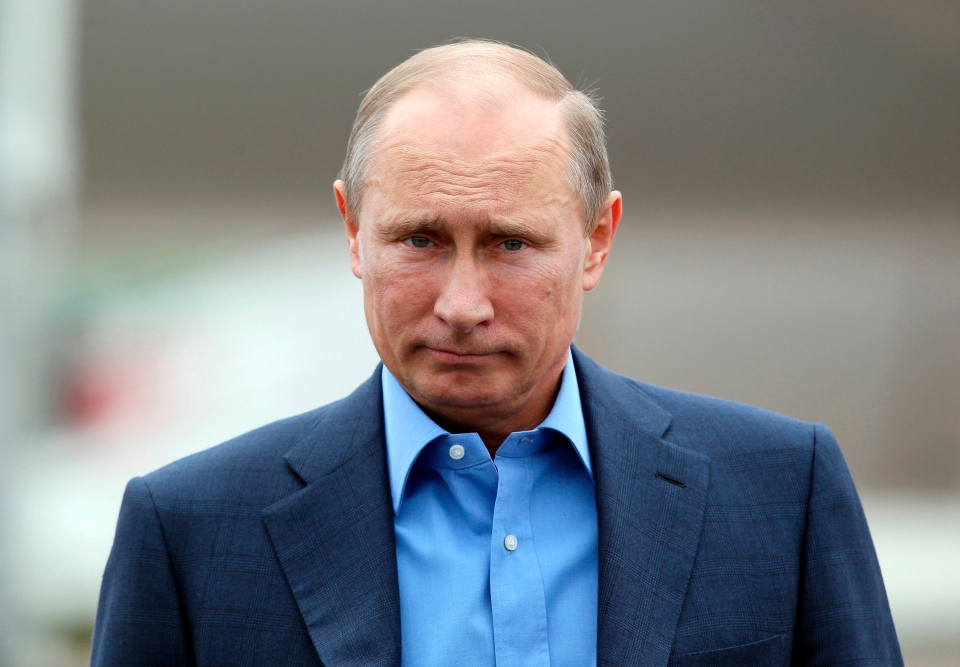
After Harper's comments, Putin cast as pariah at G8 hare on pr

Published Monday, June 17, 2013 11:26AM EDT 
ENNISKILLEN -- If this G8 meeting if any indication, the next gathering of world leaders in Russia is shaping up to be a strained affair.
A chasm has emerged between Russian President Vladimir Putin and the rest of the Group of Eight leaders over the deepening crisis in Syria.
That division was laid bare on Sunday night when Prime Minister Stephen Harper called Putin, who hosts the G20 summit in St. Petersburg in September, the outlier of the G8.
How to persuade Putin to drop his seemingly unshakable support for the regime of Syrian President Bashar Assad is the main challenge facing the other leaders at this meeting at the lakeside Lough Erne resort in Northern Ireland.
The bloody Syrian conflict has now raged for two years and at least 93,000 people have died.
Tensions escalated last week after the United States announced it would begin arming opponents of Assad's regime.
Russia -- which is in the G8 and has a permanent seat on the United Nations Security Council -- has been highly critical of the U.S. move to give weapons and ammunition to the rebels.
"One does not really need to support the people who not only kill their enemies, but open up their bodies, eat their intestines in front of the public and cameras," a Reuters report quoted Putin as saying.
"Are these the people you want to support? Are they the ones you want to supply with weapons? Then this probably has little relation to the humanitarian values preached in Europe for hundreds of years."
Putin was apparently referring to a Syrian rebel commander caught on tape last month cutting into a dead soldier and biting into one of his organs.
Russia has steadfastly stuck with the Syrian regime even as the United States claims to have proof that forces loyal to Assad have used chemical weapons. Russian officials have dismissed those claims, saying they're based on flimsy evidence
Harper -- speaking on the eve of the summit -- said Putin is unlikely to drop his support for Assad at this gathering of the leaders of the world's eight wealthiest countries.
In doing so, Harper all but called Putin the pariah of the G8 when it comes to Syria.
"Look, I think that dialogue will be interesting. I think it's important to have that kind of dialogue," Harper said Sunday night in Dublin. "But I don't think we should fool ourselves. This is G7 plus one. OK, let's be blunt. That's what this is, G7 plus one.
"We in the West have a very different perspective on this situation. Mr. Putin and his government are supporting the thugs of the Assad regime for their own reasons that I do not think are justifiable and Mr. Putin knows my view on that."
British Prime Minister David Cameron on Monday said he hoped to narrow the gap between Putin and the other leaders over the course of the two-day summit.
Two senior Canadian government officials, who spoke to journalists on the condition their names not be published, said Putin can expect an earful from the rest of the G8.
"It won't be an easy discussion," one of the officials said.
"They get heated sometimes," added the second official, "particularly on these kinds of issues."
They also underscored what's at stake in these closed-door talks.
"It's part of the ebb and flow of the G8," the second official said. "You know, we had a different position from Russia on Libya and yet we managed to have that discussion and I think the value of the G8 is the small format.
"Leaders can have frank discussions behind closed doors. So this is not the first time it's happened where there's been a core difference of opinion among G8 members. You're right, this one's serious. So was Libya."
The Harper government, meanwhile, announced Monday that Canada would give $90 million in new humanitarian assistance to Syria this year. That's on top of $100 million announced on Sunday to help Jordan cope with the fallout from the Syrian conflict.
Read more:http://www.ctvnews.ca/politics/after-harper-s-comments-putin-cast-as-pariah-at-g8-summit-1.1328939#ixzz2WUTo0rIW

Tuesday, 4 June 2013

What To Do With Syria?

When will the UN finally do something here? This war has already spilled it's borders and could end up making a larger regional war. The UN needs to come down hard on the Russians for supplying weapons to Assad's regime and get off the sidelines and go in and create a peace. We cannot and I stress cannot arm the  rebels as it is well known the the rebels have been infiltrated by Al Qaeda and the Muslim Brotherhood who cannot be trusted. The only way this will come to a conclusion is to put UN boots on the ground and try to force a resolution. The last thing I want to see is Canadian troops on the ground but with a unilateral approval from the UN it may be the only way.

We have seen this happen time and time again in the last 50 years, this is yet another example of the UN going in too little too late. After the atrocities, the use of chemical weapons and the involvement of terrorist organizations...way to go UN, you are showing the people of the world that you have their back! 


UN, France Allege Chemical Weapons Use in Syria

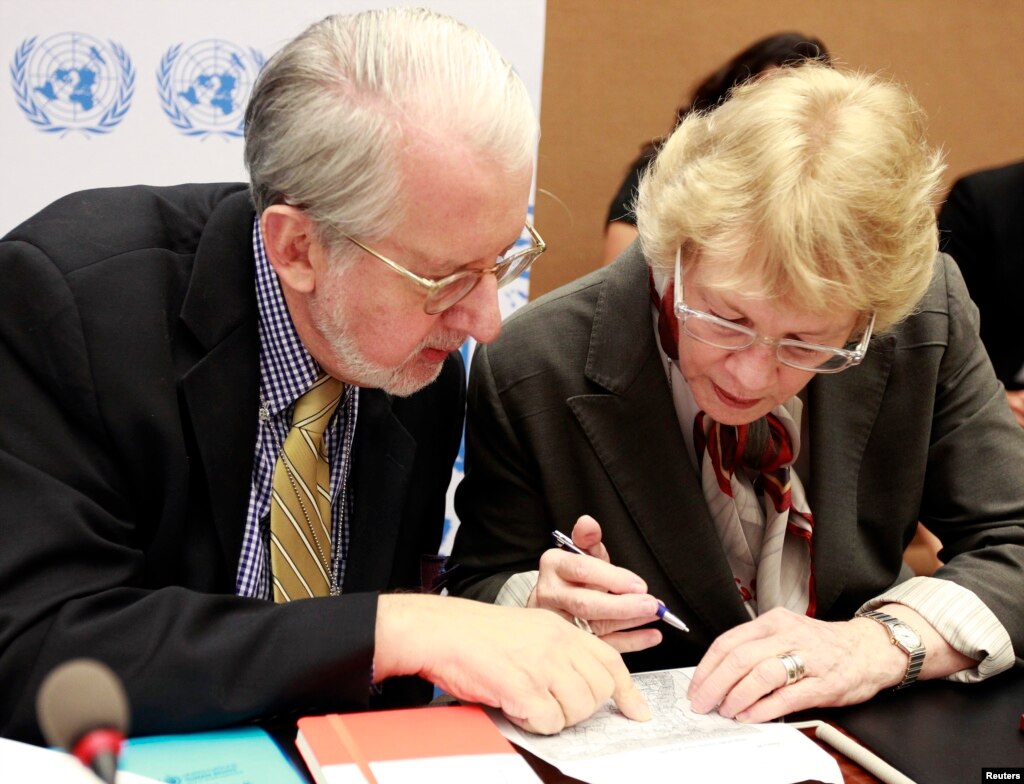
Karen Koning Abuzayd (R), member of the International Commission of Inquiry on Syria for the United Nations Human Rights Council talks to commission chairperson Paulo Pinheiro before a news conference on the presentation of their latest report at the U.N.
Karen Koning Abuzayd (R), member of the International Commission of Inquiry on Syria for the United Nations Human Rights Council talks to commission chairperson Paulo Pinheiro before a news conference on the presentation of their latest report at the U.N. VOA News
A new United Nations report says there are "reasonable grounds" to believe a limited amount of chemical weapons have been used in Syria - as France said Tuesday it is certain that the nerve agent sarin was used multiple times.

Paulo Pinheiro, chairman of the U.N. Commission of Inquiry on Syria, also stressed the human toll of the two-year conflict as he presented the report to the U.N. Human Rights Council.

"Crimes that shock the conscience have become a daily reality. Humanity has been the casualty of this war. Syria needs not a military surge, Syria needs a diplomatic surge. We cannot continue to sit idly by and watch this catastrophe unfold," said Pinheiro.

The commission's report says there is not enough evidence to determine which chemical agents have been used in Syria or who deployed them. It says those conclusions would require testing victims and collecting samples at the site of four alleged attacks.

But in Paris, French Foreign Minister Laurent Fabius said tests performed by a French laboratory showed with certainty that the deadly nerve agent sarin was used in Syria on several occasions. He said the results were handed over to the United Nations, but did not disclose where or by whom the sarin gas had been used.

The White House said Tuesday the United States needs more evidence about the use of chemical weapons in Syria before making decisions on how to respond.

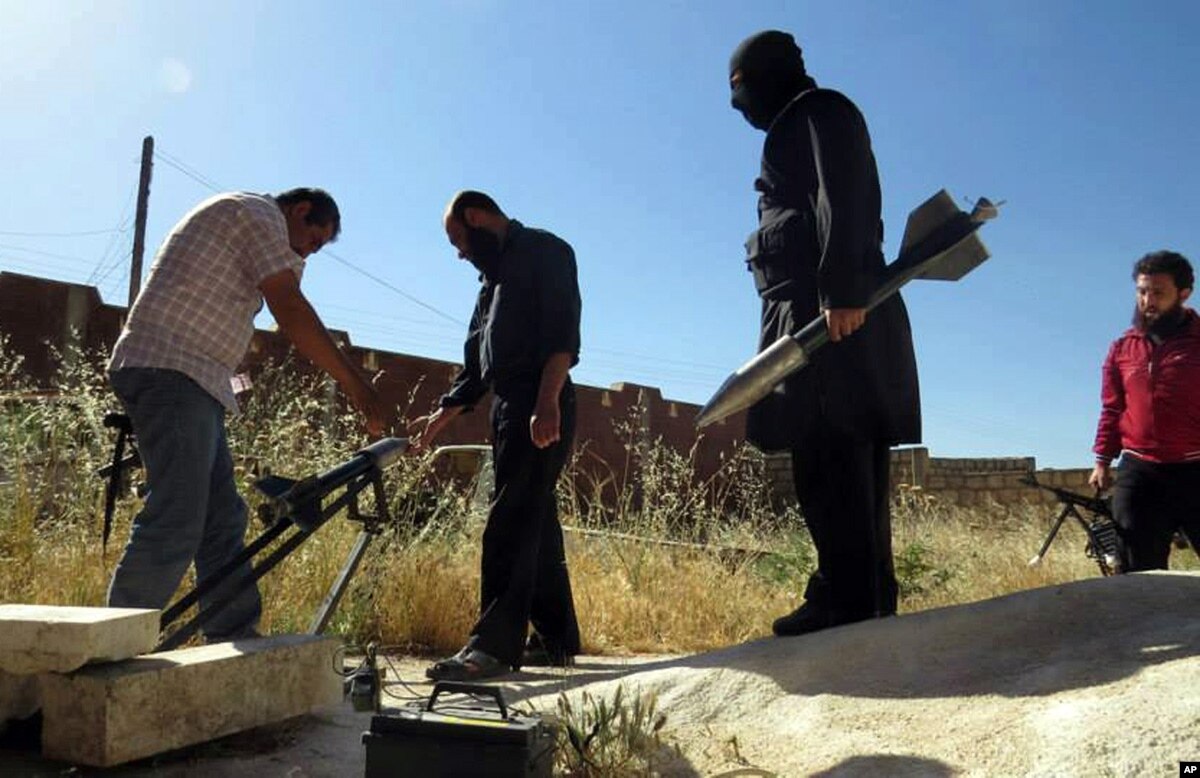
  • Syrian rebels prepare to fire locally made rockets in Idlib, northern Syria, June 4, 2013.

The U.N. report urges Syria to allow a team of U.N. investigators into the country to investigate chemical weapons use. The Syrian government has said investigators would only be able to visit one site.

Both the government and rebels trying to oust President Bashar al-Assad have accused each other of using chemical weapons and committing human rights violations.

U.N. Secretary-General Ban Ki-moon said Tuesday the atrocities detailed in the U.N. report were "sickening and staggering."

The U.N. commission said both sides in Syria are guilty of human-rights abuses, but that violations by rebels have never reached the intensity and scale of those carried out by pro-government forces.

Russia and the EU held a second day of talks Tuesday, overshadowed by friction caused by the EU's backing for the Syrian opposition and Moscow's continued support for Assad.

The summit took place as Russia and the United States continue to try to arrange an international peace conference to bring together both the Damascus government and the opposition pushing to oust the Syrian leader
.

Monday, 8 August 2011

Gulf States Take Little Action On Syria

It has taken months but finally the Arab States are making somewhat of a stand against the Assad regime in Syria.  Thousands have been slaughtered and countless more brutalized and tortured. Can the world really be looking at this ongoing assault and turning a blind eye because of lack of resources that Syria has?  I would like to think that the state of the global economy may play more of a role here and lack of funds by the world's police(U.S.A.).  I think with the rise of China and their ever growing influence on the world it it time for them to step up to the plate and act like a world leader.  No more looking the other way when it comes to this type of problem in the world, China need to lead and help put an end to such conflicts.  It is time to get on the side of the people and move forward with human rights.  But as always this will probably not happen because then the world would look to China to fix their own human rights record, something that they just are not willing to do yet.


Gulf States recall envoys, rap Syria over crackdown

Related Topics

DUBAI | Mon Aug 8, 2011 11:55am EDT
(Reuters) - Gulf Arab states broke their silence over a bloody crackdown on popular unrest in Syria, recalling their envoys in a pointed rebuke of President Bashar al-Assad's behavior and significantly deepening his international isolation.
In less than 24 hours, the island kingdom of Bahrain and oil-rich neighbor Kuwait followed Saudi Arabia's lead by summoning their ambassadors from Damascus "for consultations."
Saudi Arabia, an absolute monarchy normally loath to criticize other Arab autocrats but now wary of giving an opening to reform elements at home, pulled its envoy late on Sunday.
King Abdullah, in an extraordinary statement read on Al Arabiya television, said Syria's fierce military crackdown on nearly five months of demonstrations for more political freedoms had "nothing to do with religion, or values, or ethics."
Abdullah, who has approved billions of dollars in handouts to Saudi citizens this year in a move analysts said was aimed at buffering his monarchy from political reform pressure, issued a stern warning that Syria must be open to change.
"Syria should think wisely before it's too late and issue and enact reforms," he said. "Either it chooses wisdom on its own or it will be pulled down into the depths of turmoil and loss."
"The action of Gulf states has served to isolate the Assad regime in the Arab world, thereby signaling a major strategic shift in the region: From tacit support of the Syrian regime's action to outright condemnation," said Michael Stephens, analyst at the Royal United Services Institute (RUSI) based in Doha.
MILITARY INTERVENTION UNLIKELY
While unlikely to lead to intervention in Syria, the Gulf comments marked the sharpest Arab criticism leveled against any Arab state since a wave of protests began rocking the Middle East in January, toppling veteran rulers in Tunisia and Egypt.
On Monday, Kuwaiti Foreign Minister Sheikh Mohammed al-Sabah told reporters in parliament that he would meet his counterparts across the Gulf to discuss conditions in Syria.
"When the number of innocent people killed exceeds 2,000, it is something totally unacceptable," he said, while ruling out any military action against the fellow Arab country.
Hours later, Bahrain, which itself suppressed a protest movement in March, joined growing condemnation of Syria when Foreign Minister Sheikh Khaled al-Khalifa announced the recall of his country's ambassador. "Bahrain has summoned its ambassador for consultation and stresses the importance of prudent action," he posted on his Twitter account.
Apart from Libya's civil war, Syria's military crackdown has been the most violent outgrowth of unrest in the Arab world this year. On Monday, tanks extended operations to crush protesters in Syria's Sunni Muslim tribal heartland.
Assad's government says it is fighting criminals and armed extremists who have provoked violence by attacking its troops. Syrian rights activists and Western countries say Assad's forces have attacked peaceful protesters.
But sharp words against Syria by Gulf states are unlikely at this time to be followed by any decisive action. Analysts expect Gulf governments to stop short of supporting intervention in Syria as they did against distant Libya, where the United Arab Emirates and Qatar have sent planes to back NATO air strikes.
In ruling out military action, Kuwait echoed an Arab League statement earlier on Monday saying that the pan-Arab body would use persuasion rather than "drastic measures" to press for an end to Syria's bloodshed.
Despite a lack of appetite for military moves, Saudi Arabia has played a "game changer" role in bringing Gulf states to heap pressure on another discredited Arab leader to quit, Yemen's Ali Abdullah Saleh, RUSI's Stephens said.
Qatar, which has sought to lead Arab diplomacy as the unrest spreads, was the first to recall its envoy to Syria in July.
(Additional reporting by Mahmoud Harby in Kuwait and Erika Solomon, Mahmoud Habboush in Dubai; Editing by Mark Heinrich)

Tuesday, 7 June 2011

Syria Unrest

Just how long is the U.N. going to allow this to happen?  The government crackdown on protesters has been enough to proceed with charges for crimes against humanity.  By directly targeting mostly unarmed, peaceful protesters the Assad government has told the world that "we are not scared of you".  These dictators know that their days are numbered as they see it day in and day out all over the middle east, so why not go out in a blaze of glory?


After such deadly violence against the protesters and even children the government is claiming 120 police officers were slaughtered by protesters.  Of course there is no way to verify this because Syria will not allow reporters into the country and have been locking down as much internet as possible.  Could it have happened?  Sure but is could also be a ploy by the government to try to gain international support.  Either way I believe the right thing to do is to force the worlds will onto this regime and stop this slaughter once and for all.  I know the U.N. will have it's usual problems with China and Russia but something must happen and soon.  The retaliation for this "slaughter" will be huge and many, many people will die.  How long do we sit on the sidelines while innocent people are slaughtered?


Armed gangs murder 120 in border town: Syria

Liam Stack, Cairo
June 8, 2011

    THE Syrian government has claimed that ''armed gangs'' slaughtered at least 120 police officers, security personnel and civilians in a town near its border with Turkey on Monday. It says it will act ''with force'' to restore control.
    If true, the violence suggests a vicious shift in the uprising against the regime of President Bashar al-Assad.
    Many opposition figures and local residents, however, have disputed official reports of what happened in Jisr al-Shughur.
    Some said the violence was set off by the defection of soldiers sent to besiege the town on Saturday, after a number of them sought refuge, according to a statement released by an opposition group, Local Co-ordinating Committees in Syria.
    State media described a ''massacre'' at the hands of unidentified gunmen and said residents were ''pleading'' for the army to intervene. But few details were provided and no images. Instead, an ever-higher estimate of fatalities scrolled across the bottom of Syrian television screens throughout the day, against a video backdrop of children frolicking in ponds and singing patriotic songs.
    There have been sporadic armed clashes with opponents of the government during the Syrian revolt, although the protests in most Syrian cities have been peaceful.
    Human rights groups have not ruled out the possibility of violent reprisals against troops by people who lived in Jisr al-Shughur, an area that has a history of support for the out- lawed Muslim Brotherhood.
    Telephone and Internet service to the town was disrupted on Monday, but residents reached by phone described chaotic scenes of mass flight and street barricades.
    ''The army split; the confrontation is between them,'' Saeb Jamil, a local activist who said he was helping people flee to the nearby Turkish border, said. ''The army is confronting the army.'' It was unclear from residents' accounts if local people took part in the conflict. Camille Otrakji, a Damascus-born political blogger living in Montreal, said Syria was a tinderbox waiting for a spark.
    ''You can never control everybody on the streets. If you get people angry enough, the arms are there, and they're going to go for it,'' he said.
    NEW YORK TIMES